

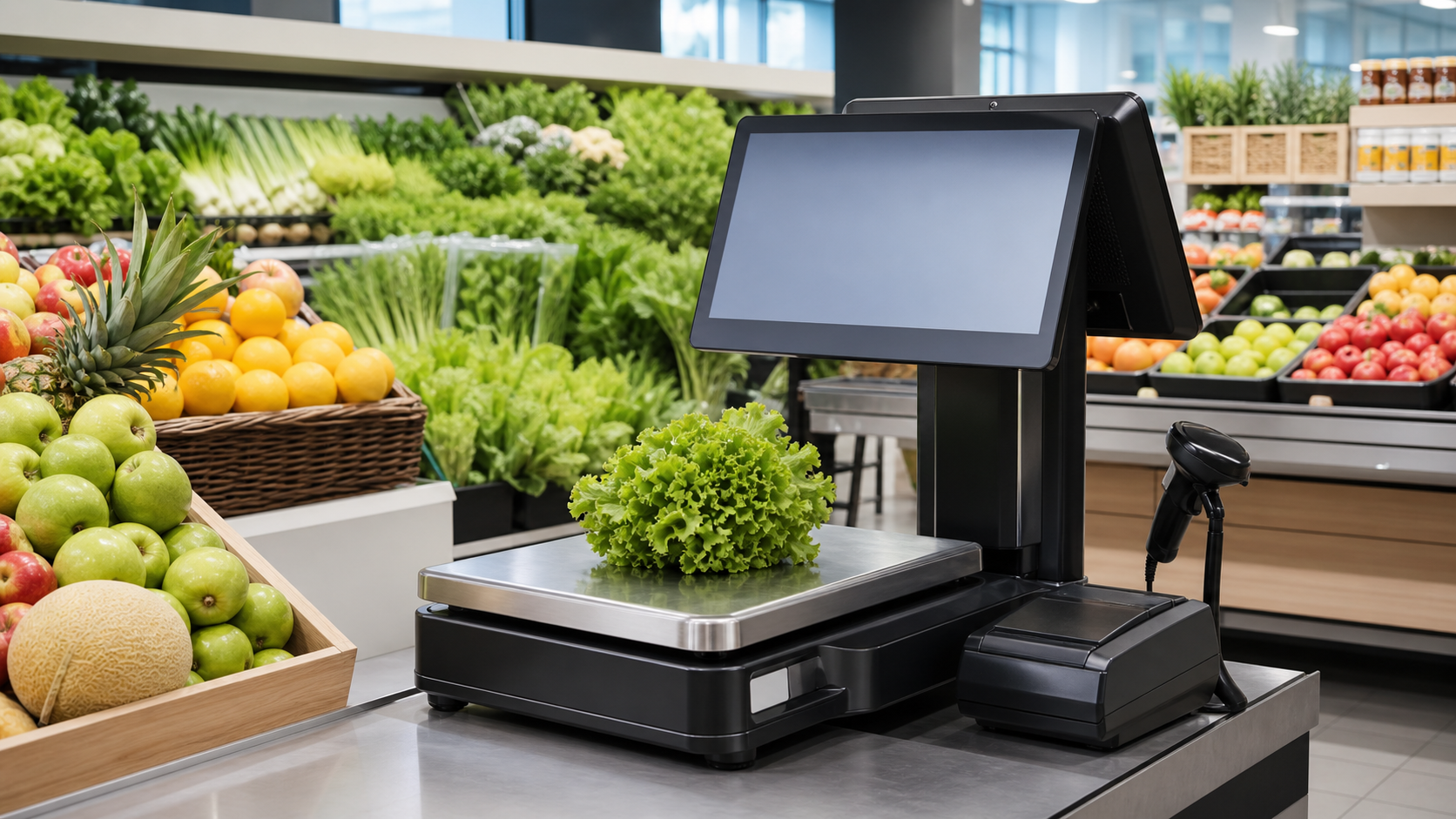
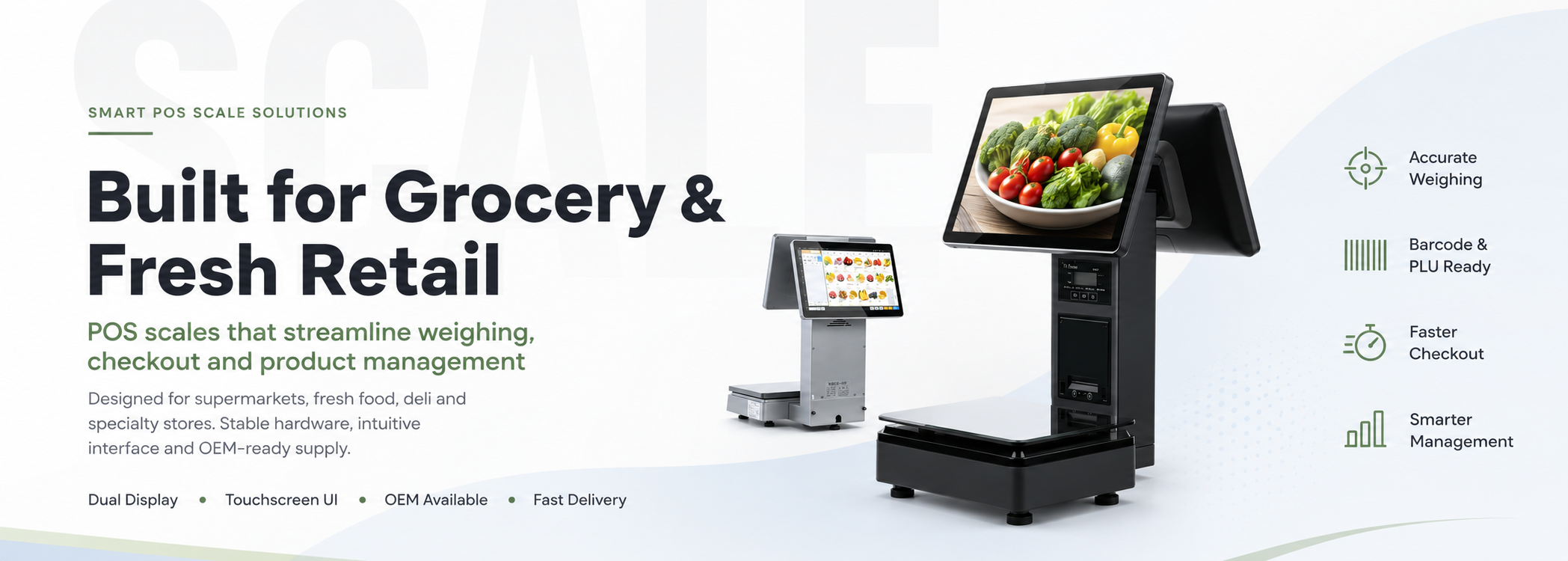
Fresh food retail is one of the most demanding checkout environments. A cashier may need to identify produce, weigh items, print labels, apply discounts, scan packaged goods, and complete payment within a short customer interaction. When the store is busy, small mistakes can quickly become long queues, incorrect pricing, and customer complaints.
This is why more supermarkets, fruit shops, grocery stores, and fresh food retailers are considering the AI POS scale. By combining weighing hardware, touchscreen operation, product recognition, receipt printing, and POS software support, an AI POS scale system can make checkout faster and more accurate.
For business owners, the value is not only automation. The real benefit is consistency: better product identification, fewer manual steps, cleaner counter design, and more reliable data for daily store management.
What Is an AI POS Scale?
An AI POS scale is a weighing checkout terminal designed for retail scenarios where products are sold by weight. Unlike a basic electronic scale, a smart POS scale can combine multiple functions in one device:
- High-precision weighing platform
- Touchscreen cashier interface
- AI visual recognition for produce or fresh goods
- Built-in receipt or label printer
- Barcode and QR code scanning
- Customer-facing display
- POS software integration
- Network connection for product database and sales reporting
In a traditional workflow, the cashier must search for the correct product code or select the item manually. With AI-assisted recognition, the system can help identify the item on the scale and reduce the number of manual touches required.
Why Fresh Food Stores Need Smarter Weighing Checkout
1. Product Identification Can Be Slow
Fresh produce often has many similar-looking items. New staff may confuse different apple varieties, leafy vegetables, or seasonal fruit. Even experienced cashiers can slow down when the store carries a large produce catalog.
An AI POS scale helps by narrowing the product selection and making the checkout process more intuitive. This can reduce training time and improve consistency across different employees.
2. Pricing Errors Affect Profit
Incorrect product selection can lead to undercharging or overcharging. Undercharging reduces margin, while overcharging damages customer trust. In high-volume supermarkets, small errors repeated many times can become a serious business issue.
A smart weighing cash register helps stores standardize product selection and pricing. When connected to a product database, it can also support fast price updates, seasonal promotions, and category management.
3. Checkout Speed Shapes Customer Experience
Customers buying fresh food often expect fast service. If the cashier needs to search through many product pages, the queue gets longer. A POS scale system with touchscreen categories, barcode support, and AI recognition can shorten the checkout path.
4. Store Data Becomes More Useful
When weighing, product selection, and sales records are handled through one POS terminal, store owners can better understand which categories sell well, when inventory moves fastest, and where pricing adjustments are needed.
Core Features to Compare When Buying an AI POS Scale
Weighing Accuracy and Stability
The scale must be accurate and stable enough for commercial retail. For fresh produce, even small errors can affect customer trust and store margin. Buyers should check weighing capacity, precision, calibration support, and local compliance requirements.
AI Recognition Capability
AI recognition is useful only when it fits the store catalog. Ask whether the system can learn new products, support local produce names, and work under real store lighting. The goal is not to replace the cashier completely, but to help staff identify items faster and more accurately.
Dual Screen Design
A customer-facing screen can show item name, weight, unit price, total price, promotions, or order details. This improves transparency and can reduce disputes during checkout. For supermarkets and fruit shops, dual-screen POS scales often create a more professional customer experience.
Printer Options
Some stores need receipt printing at checkout, while others need label printing for pre-packed goods. Check whether the device supports the required paper width, label format, barcode printing, and replacement consumables.
Software and Peripheral Compatibility
A smart POS scale should fit into the existing retail system. Confirm whether it supports your POS software, product database, payment device, barcode scanner, cash drawer, and network environment.
Durability for Fresh Food Environments
Produce areas can involve moisture, dust, fruit juice, and frequent cleaning. Buyers should evaluate the material, screen protection, weighing plate design, ventilation, and maintenance process before choosing a model.
AI POS Scale vs Traditional Electronic Scale
A traditional electronic scale is usually enough for simple weighing and price calculation. However, it may not support modern retail data workflows. An AI POS scale is more suitable when the store needs product recognition, cashier operation, sales records, receipt printing, and customer display in one system.
For a small market stall, a basic scale may be sufficient. For supermarkets, chain fruit stores, fresh food retailers, and stores preparing for digital management, a smart POS scale system can be a stronger long-term investment.
Recommended Use Cases
An AI POS scale can be especially useful for:
- Supermarkets with fresh produce sections
- Fruit and vegetable stores
- Butcher shops and seafood counters
- Organic grocery stores
- Retailers selling bulk food by weight
- Chain stores that need standardized checkout hardware
For a complete smart weighing checkout solution, buyers can review the 15.6-inch AI visual recognition POS scale or the Android AI POS scale system. These types of devices are designed for fresh retail scenarios where weighing, product selection, printing, and checkout need to work together.
How to Choose the Right POS Scale Supplier
Because AI weighing checkout involves both hardware and software compatibility, the supplier matters. A good supplier should understand retail workflows and provide clear technical guidance before the order.
Before buying, ask:
- Can the scale connect with my POS software or product database?
- Does the system support local product names and categories?
- Can the AI recognition model be updated or trained?
- What printer type and paper size does the device use?
- Is the customer display included?
- What warranty and after-sales support are available?
- Can the hardware be customized for bulk or OEM projects?
For distributors, supermarket solution providers, and system integrators, OEM flexibility can be especially important. Hardware configuration, logo branding, language settings, and peripheral options may need to change from project to project.
Conclusion
An AI POS scale is more than a weighing device. It is a smart checkout terminal for fresh food retail, combining weighing, product recognition, cashier operation, printing, and data management in one solution.
For supermarkets and fresh food stores, the right POS scale system can reduce cashier errors, speed up checkout, improve transparency, and support more professional store operations. As retail competition increases, stores that modernize their weighing checkout process can create a better experience for both staff and customers.
FAQ
Can an AI POS scale recognize all fruits and vegetables automatically?
Recognition depends on the product database, image model, lighting, and store setup. In practice, AI recognition is best used to assist the cashier and reduce manual searching, not to remove human confirmation completely.
Is a POS scale suitable for small grocery stores?
Yes, if the store sells many products by weight or wants better checkout data. For very small stalls with simple pricing, a basic electronic scale may still be enough.
Can a smart POS scale print labels?
Many POS scale systems can support receipt or label printing, but the exact function depends on the printer module and software. Buyers should confirm paper size, label format, and barcode printing support before ordering.